

Themes, Motifs
and
symbols
Themes
The theme is the universal message from the author.


Symbols
Symbols are objects, characters, figures, and colours used to represent abstract ideas or concepts.


Motifs
Motifs are recurring structures, contrasts, and literary devices that can help to develop and inform the text’s major themes.
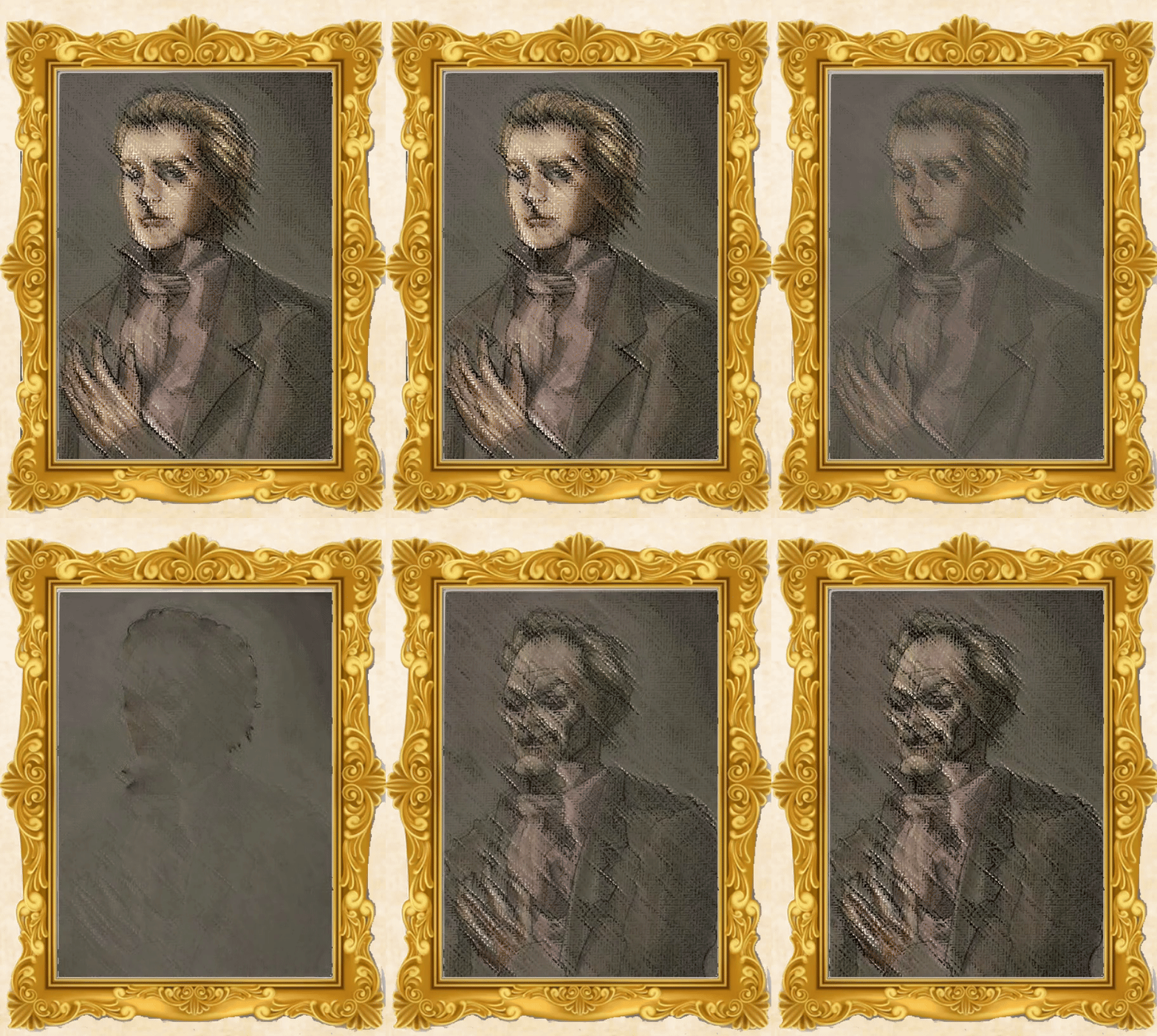


Art as a Mirror
-
This theme is exemplified by the titular portrait.
-
Dorian Gray's image reflects his conscience and his true self, and serves as a mirror of his soul.
-
This fact echoes Wilde's statement (found in the preface) that "It is the spectator...that art really mirrors."
-
However, this theme first appears earlier in the preface, with Wilde's contention that "the nineteenth-century dislike of realism is the rage of Caliban (A savage and deformed slave a character in The Tempest by William Shakespeare) seeing his own face in a glass."
-
Realism is a genre of artistic expression that is said to have shown the 19th century its own reflection.
-
The fear that Dorian expresses when viewing the painting, and the emotions that he seeks to escape:
-
through sin, drug addiction, and even murder,
-
might be considered an expression of his rage at laying eyes upon his true self.
-
-
The idea of reflectivity also recalls a major mythical influence on the novel: the story of Narcissus.
-
Dorian, like Narcissus, falls in love with his own image, and is ultimately destroyed by it.


The Art of Living (or Living through Art)
-
This theme is expressed most prominently in the character of Lord Henry, and in the "new hedonism" he espouses.
-
Lord Henry openly approaches life as an art form, seeking to sculpt Dorian's personality, and treating even his most casual speeches as dramatic performances.
-
Most notably, he pursues new sensations and impressions of beauty with the amorality of an artist: as Wilde writes in the preface,
-
"No artist has ethical sympathies."
-
This latter characteristic is the one that leaves the deepest impression on Dorian's character.
-
-
However, although both men fancy themselves artists at living, their flaw lies in their blatant violation of the rule given in the first line of the preface:
-
"To reveal art and conceal the artist is art's aim."
-
Dorian and Lord Henry both strive to reveal themselves in their "art."
-
-
Wilde also explores this theme by blurring the line between life and art.
-
Characters in the novel include actresses who live as though they are constantly on stage, and a painter who values a friendship predominantly because the relationship improves his ability to paint.
-
Dorian himself consciously bases his life and actions on a work of art:
-
a book given to him by Lord Henry.
-
Vanity as Original Sin
-
Dorian's physical beauty is his most cherished attribute, and vanity is, as a consequence, his most crippling vice.
-
Once a sense of the preciousness of his own beauty has been instilled in him by Lord Henry, all of Dorian's actions,
-
from his wish for undying youth at the beginning of the novel;
-
to his desperate attempt to destroy the portrait at the end, are motivated by vanity.
-
-
Even his attempts at altruism are driven by a desire to improve the appearance of his soul.
-
Throughout the novel, vanity haunts Dorian, seeming to damn his actions before he even commits them;
-
vanity is his original sin.
-
-
Dorian's fall from grace, then, is the consequence of his decision to embrace vanity - and indeed, all new and pleasurable feelings - as a virtue.
-
In the preface to the novel, Wilde invites us to ponder the inescapably of vanity in our own relationship to art when he states that:
-
"it is the spectator, and not life, that art really mirrors."
-
-
If we see ourselves in art, and find art to be beautiful, then it follows that we, like Dorian, are in fact admiring our own beauty.

The Duplicity of One's Public and Private Selves

-
This theme is prominent in much of Wilde's work.
-
It plays a central role in The Importace of Being Earnest, and is prominent throughout this novel, as well.
-
-
In addition to the protagonist, many of the novel's characters are greatly concerned with their reputations.
-
Lord Henry and Basil Hallward both counsel Dorian on how to best preserve his good status in the public eye.
-
When crimes are committed, it is not personal absolution that anyone is concerned with, but whether or not the guilty party will be held responsible by the public.
-
In this way, each character in the novel possesses an awareness of a split identity:
-
one that is defined by the public, and one that they define themselves
-
-
The figure of Dorian is an allegorical representation of this condition.
-
The portrait is a literal visualization of Dorian's private self, the state of his soul, while Dorian himself looks perpetually young, beautiful, and innocent.
-
Much of Wilde's social commentary in the novel springs from his manipulation of this theme.
-
People's responses to Dorian constantly highlight the overwhelming superficiality of Victorian London (if not people in general).
-
Because Dorian always looks innocent, most of the people he encounters assume that he is a good, kind person.
-
-
Dorian literally gets away with murder because people are automatically more willing to believe their eyes than anything else.
The Value of Beauty and Youth

-
Lord Henry claims to value beauty and youth above all else.
-
It is this belief, when imparted to Dorian that drives the protagonist to make the wish that ultimately damns him.
-
When Dorian realizes that he will keep his youthful appearance regardless of whatever immoral actions he indulges in, he considers himself free of the moral constraints faced by ordinary men.
-
He values his physical appearance more than the state of his soul, which is openly displayed by the ever-increasing degradation of the portrait.
-
This superficial faith in the ultimate value of youth and beauty is therefore the driving mechanism behind the protagonist's damnation.
-
In this way, The Picture of Dorian Gray may be read as a moralistic tale warning against the dangers of valuing one's appearance too highly, and of neglecting one's conscience.
-
It is important to bear in mind that the beauty that Dorian incessantly pursues is a beauty defined by a purely artistic sensibility, as opposed to a humanitarian one.
-
When faced with the news of his fiance's suicide, Dorian views the event as satisfyingly melodramatic.
-
His obsession with aesthetic beauty prevents Dorian from attending to the pangs of his own conscience.
Influence and Corruption

-
Dorian begins the novel as an innocent youth.
-
Under Lord Henry's influence he becomes corrupt, and eventually begins corrupting other youths himself.
-
-
One of the major philosophical questions raised by this novel is that of where to locate the responsibility for a person's misdeeds.
-
If one engages in a moralistic reading, The Picture of Dorian Gray can be seen as a lesson in taking responsibility for one's actions.
-
Dorian often points to Lord Henry as the source of his corruption.
-
However, when contemplating the plights of others, Dorian lays the blame at their own feet rather than considering the role that he might have played in their downfall.
-
Homosexuality

-
In the novel, there are strong homosexual undertones in the relationships between the three central characters:
-
Basil Hallward & Dorian & Lord Henry
-
As well as between Dorian and several of the young men whose lives he is said to have "ruined", most notably Alan Campbell.
-
In his revision of the novel for its official release, after it appeared in Lippincott's Monthly Magazine, Wilde removed all of the most blatant references to homosexuality.
-
However, the idea of sexual affection between men proved too integral to the characters and their interactions to be entirely expunged from the novel.
-
This theme has prompted many critics to read the novel as the story of a man's struggle with his socially unacceptable proclivities.
-
Indeed, some feel that Wilde was working out his own conflicted feelings on the subject through the novel.
-
The language here, and the use of the word "shame," suggests that Dorian's "sins," although they are never explicitly described, may be of a sexual nature.
-
One has to remember that in the Victorian age, attitudes to homosexuality are very different from what they are today.
Art vs. Life

-
The novel presents a contrast between art and life.
-
Art possesses beauty and form; it is contrasted with the ugliness and shapelessness of real life.
-
Lord Henry encourages Dorian to treat his own life as if it were a work of art.
-
He must experience it fully, as one would a piece of art, but at the same time remain detached from it, in the way that one might appreciate a great painting or a play.
-
-
This involves a paradox:
-
He must be at once involved and uninvolved, fully participating, not drawing back from anything, but always remaining a spectator.
-
-
Such is Lord Henry's notion.
-
He is depicted as being a connoisseur of all the arts and surrounds himself with objects of beauty. He maintains the essential detachment that enables him, or at least he claims it does, to avoid the pain of the world.
-
It also means that he does not adopt moral positions on anything, since that would mean taking life more seriously than art.
-
-
For Lord Henry, the purpose of life is not to exhibit one's moral prejudices but to contemplate beauty.
-
The contrast between art and life can be seen in the chapters that describe Dorian's walk to the theatre where Sibyl Vane performs and on his ride to the opium den.
-
In both instances, the sordidness of these parts of London are described.
-
-
Dorian feels this keenly, and he takes refuge in the art that Sibyl creates.
-
Her value to him is that she enables him to live out Henry's creed.
-
When she ceases to show an interest in art, Dorian ceases to be interested in her.
-
On the ride to the opium den, Dorian's position has changed. He now embraces the ugliness of life. He has forgotten the creed that Henry taught him.
-
-
He has exchanged art for life-and that itself is a sin, in Oscar Wilde's credo.
Sensual Gratification

-
Lord Henry's philosophy of life, which is adopted by Dorian, is that the senses should be indulged to the full.
-
In the fleeting sense experience lies the intensity of life, and all life is simply a series of these intense moments.
-
This is not intended as a mindless indulgence for the sake of it, but is a conscious quest for beauty.
-
-
Dorian thus learns to cultivate all kinds of sense experience, passions and sensations in the pursuit of beauty.
-
He studies exotic perfumes, he collects musical instruments and precious stones. He once went to a costume ball wearing an outfit covered with 560 pearls.
-
-
Neither Henry nor Dorian believe in any restrictions on desire, because desire is life itself, whereas self-denial in the name of morality is exactly that-a denial of life.
-
Henry's belief is that self-development, not self-restraint, is the purpose of life.
-
He describes this philosophy as a new Hedonism.
-
It is a refined understanding and appreciation of life that amounts to a form of spirituality.
-
-
Henry's friend and disciple Dorian believes that in indulging the senses he is freeing them to be what are intended to be, a channel for the experience of beauty.
-
In chapter 11, he states his belief that the senses have never been properly understood before:
-
"they had remained savage and animal merely because the world had sought to starve them into submission or to kill them by pain, instead of aiming at making them elements of a new spirituality, of which a fine instinct for beauty was to be the dominant characteristic"
-
Hedonism ?

-
the pursuit of pleasure; sensual self-indulgence.
-
the ethical theory that pleasure (in the sense of the satisfaction of desires) is the highest good and proper aim of human life.
The Opium Dens

-
The opium dens, located in a remote and derelict section of London, represent the sordid state of Dorian.
-
He flees to them at a crucial moment. After killing Basil, Dorian seeks to forget the awfulness of his crimes by losing consciousness in a drug-induced stupor.
-
Although he has a canister of opium in his home, he leaves the safety of his neat and proper parlour to travel to the dark dens that reflect the degradation of his soul.

James Vane

-
James Vane is less a believable character than an embodiment of Dorian’s tortured conscience.
-
As Sibyl’s brother, he is a rather flat caricature of the avenging relative.
-
Still, Wilde saw him as essential to the story, adding his character during his revision of 1891.
-
-
Appearing at the dock and later at Dorian’s country estate, James has an almost spectral quality.
-
Like the ghost of Jacob Marley in Charles Dickens’s A Christmas Carol, who warns Scrooge of the sins he will have to face, James appears with his face “like a white handkerchief” to goad Dorian into accepting responsibility for the crimes he has committed.
-
The Yellow Book

-
Lord Henry gives Dorian a copy of the yellow book as a gift.
-
Although he never gives the title, Wilde describes the book as a French novel that charts the outrageous experiences of its pleasure-seeking protagonist (we can fairly assume that the book in question is Joris-Karl Huysman’s decadent nineteenth-century novel À Rebours, translated as “Against the Grain” or “Against Nature”.
-
-
The book becomes like Holy Scripture to Dorian, who buys nearly a dozen copies and bases his life and actions on it.
-
The book represents the profound and damaging influence that art can have over an individual and serves as a warning to those who would surrender themselves so completely to such an influence.
The Picture

-
The picture (painting) of Dorian Gray,
-
“the most magical of mirrors,” shows Dorian the physical burdens of age and sin from which he has been spared.
-
-
For a time, Dorian sets his conscience aside and lives his life according to a single goal:
-
achieving pleasure.
-
-
His painted image, however, asserts itself as his conscience and hounds him with the knowledge of his crimes:
-
there he sees the cruelty he showed to Sibyl Vane and the blood he spilled killing Basil Hallward.
-
Homoerotic Male Relationships

-
The homoerotic bonds between men play a large role in structuring the novel.
-
Basil’s painting depends upon his adoration of Dorian’s beauty;
-
Lord Henry is overcome with the desire to seduce Dorian and mould him into the realization of a type.
-
-
This camaraderie between men fits into Wilde’s larger aesthetic values, for it returns him to antiquity, where an appreciation of youth and beauty was not only fundamental to culture but was also expressed as a physical relationship between men.
-
As a homosexual living in an intolerant society, Wilde asserted this philosophy partially in an attempt to justify his own lifestyle.
-
For Wilde, homosexuality was not a sordid vice but rather a sign of refined culture.
-
As he claimed rather romantically during his trial for “gross indecency” between men, the affection between an older and younger man places one in the tradition of Plato, Michelangelo, and Shakespeare.
-
The Colours White and Red

-
Colours symbolic of purity and innocence and sin and gore populate the story at crucial moments.
-
One of the first noticeable examples is when Sybil’s Vane’s body is described as “little” and “white”, emphasizing her ruined purity.
-
Dorian’s devolvement into a monstrous, unnatural figure is stained with bloody colours.
-
Increasingly, as we move towards the climax of the novel, redness seems to gather until Dorian starts to see blood-like marks on his portrait.
-
These colour symbols create a visual surface in the text, showing us clearly the difference between right and wrong and giving the action a kind of painted effect.